





Runescribe in Dungeons & Dragons 5e

The Traveler's Guide to Aellorah
Runescribe
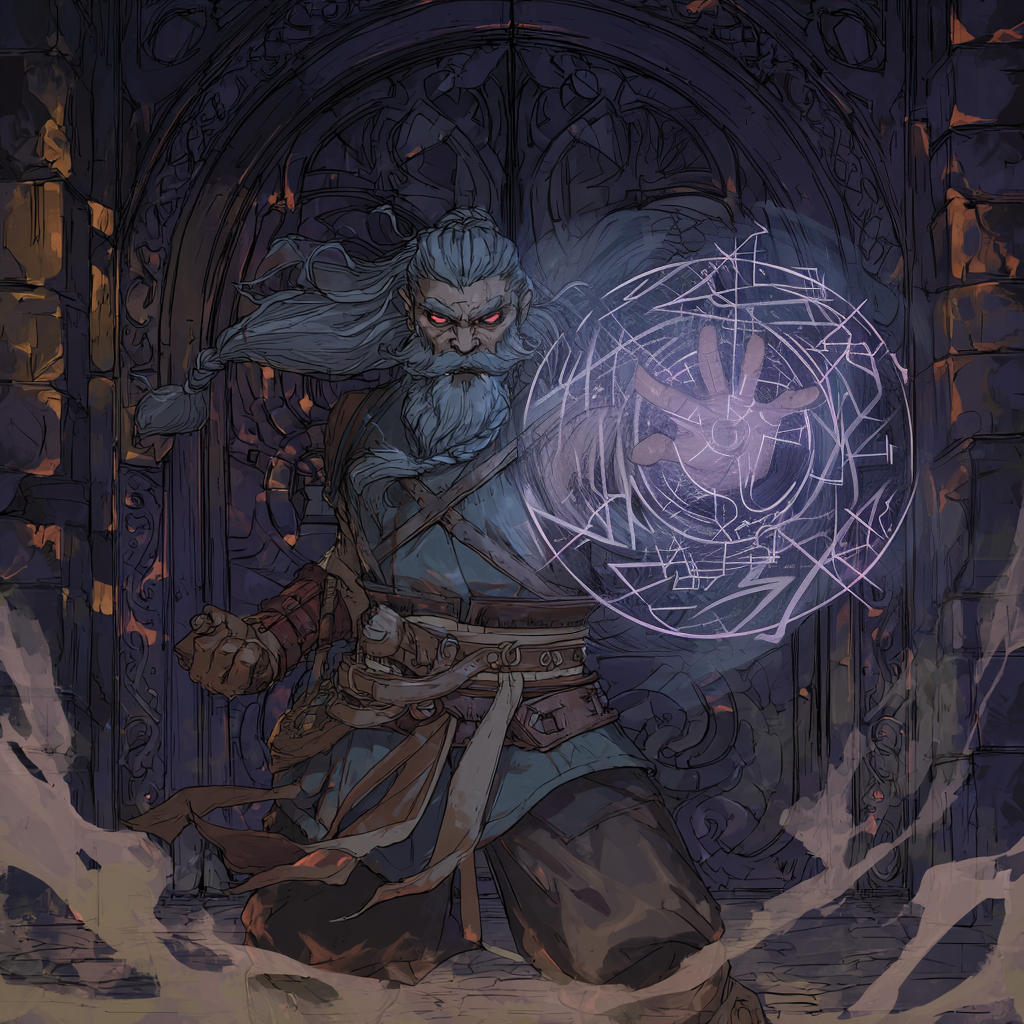
Runescribing is the most ancient form of magic on Aellorah, having been passed down over generations after the first seven runes were taught to the Dwarves by Aellor. While the mainland Dwarves of Reshyk have mostly forgotten about it, pursuing different more flexible forms of magic, the Ashenfolk and Deskarfolk still practice the old ways. Runescribing is the art of inscribing or invoking runes, physical manifestations of words of power that have the ability to produce spell-like effects, as well as modify the physical and metaphysical properties of objects and creatures they are inscribed onto. The Runescribe uses these runes to overwrite the fundamental properties of the physical world and shape it to their will. While modern magic may be more flexible, it requires far more study and is far more error-prone; whereas runes can do things a Wizard can only dream of with but a flick of the wrist and the quick tracing of an arcane symbol.
Rune Magic
At 1st-level, you have the ability to use runic magic, the oldest form of magic in Aellorah. You gain access to seven basic runes, and have a reserve of Flow that you can draw upon to scribe or invoke these runes. Every two levels, you learn an additional rune of your choice. Your spellcasting ability is Intelligence. The act of Invoking a rune involves drawing the rune in the air, which produces a spell-like effect; while Scribing a rune involves drawing the rune on an object or creature, which modifies the physical or metaphysical properties of that object or creature. You may also encounter a material called Tekrum which, when a rune is scribed upon its surface, can store the rune to be used later by you or someone else. If you scribe a rune onto Tekrum, you cannot scribe or invoke the rune that was scribed upon it until the talisman has been used. Similarly, a rune that has been scribed onto an object or creature cannot be scribed or invoked again until the effect wears off, or it is dispelled or dismissed by you, unless the rune's description says otherwise. Scribed runes without an explicit duration persist until they are dispelled or dismissed. When you scribe a rune onto a talisman, you pay the scribe cost, and the talisman can then be used with an action. All runes have only Somatic components, but to use a talisman, you must recite the name of the rune to activate it. Once a talisman has been used, the rune fades and the talisman crumbles to dust. Both scribed and invoked runes can be dismissed before their effects end.
Each rune has an associated cost to scribe or invoke it, though the cost to scribe and the cost to invoke may differ depending on the rune. This cost is deducted from your Flow Reserve, abbreviated 'FR'. Once your Flow Reserve is depleted, you cannot scribe or invoke runes with a cost until you have completed a long rest. Your Flow Reserve increases as you gain Runescribe levels, and is shown on the Runescribe class table in the 'FR' column. Your Flow Reserve is fully recovered at the end of a long rest. The potency of your runes is represented by the 'RP' (Rune Potency) column on the Runescribe class table, representing how much material your runes can affect, how strong the effects are, etc. The DC to dispel a rune with the 'Dispel Magic' spell, or to counter with 'Counterspell', is 10 + twice the base cost of the scribed or invoked rune. Runes with a cost of 1 or 0 are automatically dispelled or countered.
At 1st-level, you know seven runes of your choice. Some runes have level or vocation requirements.
Vocation
At 2nd-level, you choose your Runescribe vocation, which is your particular specialty in the craft. Your vocation gives you access to a limited list of additional runes not available to other vocations, as well as other subclass features. Your choice grants you features at 2nd level, and again at 6th, 10th, and 14th level.
Runic Synthesis
At 5th-level, you gain the ability to combine runes, allowing you to create more complex effects. When you invoke or scribe a rune, you can combine it with another rune by paying its associated cost to modify the invoked or scribed rune's effects according to the Synthesis effect of the second rune. You can combine two other runes at first. You can combine a rune with itself if desired. All synthesized runes apply to the original invoked or scribed rune. You can synthesize the same rune multiple times, and their effects will stack. If synthesizing the same rune multiple times, the cost is paid each time. The number of runes you can combine with your scribed or invoked rune increases by 1 as you gain Runescribe levels: 5th level (2), 11th level (3), and 17th level (4).
Runic Procedures
At 10th-level, you gain the ability to change the behavior of your runes with a short set of instructions, up to 10 words. You can designate triggers for your invoked runes, delay activation for scribed or invoked runes, and more. There are a number of keywords that can be used to modify a rune's behavior by specifying the parameters for these keywords. The keywords that can be used are:
- Delay. By specifying a time period (ie: "5 minutes"), you can delay the activation of an invoked or scribed rune. You can delay a rune's activation for up to 1 hour. If combined with the TRIGGER keyword, this delay occurs after the TRIGGER is activated.
- Trigger. By specifying something that should trigger the activation of the rune, you can ensure it is only activated by certain conditions; anything from specific people, races, even the weather. The trigger can be whatever you want, but a rune will expire after 24 hours if not triggered.
- Range. By specifying a range for a trigger, you can designate a distance that the trigger must be from the rune for it to activate. Range must be specified in feet. The maximum range that can be specified is 100 ft.
- Duration. By specifying a duration, you can control how long the rune's effects last before the rune is automatically dismissed.
- Name/Link. Allows you to name a scribed or invoked rune, which can then be "linked" to another. The "linked" rune can only activate once the named rune has activated. If no other conditions are specified, the rune activates immediately once the named rune is activated. Linked runes can be activated from any distance and across planes.
- Direction. Allows you to specify a direction for the invoked rune's effects.
- Then. Specifies behavior that happens after the preceding condition/s are met.
- While. Specifies that the rune should remain active while the specified condition is met.
An example of a procedure that can be used would be "DELAY 5 minutes OR TRIGGER human present RANGE 5 feet". These 7 words will ensure that the rune will only trigger after 5 minutes or if a Human comes within 5 feet of the rune. If you are not specific, undefined behavior can be observed; for example, if you specify "TRIGGER mara present", the rune will trigger when ANY person named 'Mara' is present.
Runic Perception
At 18th-level, you gain the ability to peer into the plane of Sara'lor to see magic given shape, and see the bonds and connections that form enchantments. Once per day as an action, you can activate this sight, allowing you to see Aurum runes on all objects and creatures that define their existence. This ability lasts for up to 1 minute and requires concentration. If you lose concentration, you become blinded for 1 minute. While this ability is active, you can:
- See all magical properties of an object or creature, and all spells affecting them. You can identify magical traps, spells affecting a creature, enchantments on an item, curses, and Flowborne diseases. You can identify the school of magic, spell level, the exact effects, and even the spell if applicable. As an action, you can make an Arcana check with a DC equal to 10 + the spell's level, identifying its effects on a success. If there is no applicable spell level, your DM determines the DC.
- See lingering magical effects of spells cast within the last hour. As an action, you can make an Arcana check at disadvantage with a DC equal to 10 + the spell's level to identify the spell and its effects, as identifying spells that are no longer active is more difficult. If there is no applicable spell level, your DM determines the DC.
- See the location of creatures obscured by invisibility, darkness, or illusions. You do not gain the ability to see through these forms of concealment, but you know that they are there. You cannot see through the mask crafted by an illusory disguise, but you know that a disguise is being used. This ability negates disadvantage when making attack rolls.
- See magical bonds and connections coming from other planes, appearing as wispy tethers to far off places. If you have a blade made of pure Zegroniten, you can even sever these bonds, causing enchantments and spells to malfunction.
Augmenter
The Augmenter uses quick infusions on their equipment, and even their own body, to bolster their defenses and deliver devastating magical attacks through their weapons. Where other Runescribes might stay behind those wearing armor and support from afar, the Augmenter is the one wearing the armor and running into the fray.
Runes of Augmentation. At 2nd-level, you gain access to an expanded list of runes that you learn automatically as you gain levels in Runescribe. The following Runescribe runes are added to your list of known runes:
| Level | Runes |
|---|---|
| 2nd | ??? |
| 6th | ??? |
| 11th | ??? |
| 14th | ??? |
Combat Proficiency. At 2nd-level, you gain proficiency with medium and light armor, and martial melee weapons.
Runic Strikes. At 6th-level, you gain the ability to infuse your weapon with the scribe effects of your runes as a bonus action by passing your hand over your weapon. When you hit an object or creature with your weapon attacks, you can deliver the scribed rune's invoke effect through the attack. When you do this, the effects only apply to the target of your attack. You cannot synthesize runes with a weapon infusion. After the rune's effects are delivered through an attack, the rune fades from your weapon. Additionally, you can scribe or invoke runes by drawing them with your weapon; but when doing so, you cannot synthesize other runes.
Persistent Augmentation. At 11th-level, you can choose one of your Runes of Augmentation that are applied to yourself to make persistent, ignoring its normal duration. The rune's effects will persist until dismissed or dispelled. You can change the rune you have made permanent after a long rest.
Potent Infusions. At 14th-level, you can use a rune infused on your weapon twice before it fades. You pay the cost for the rune only once.
Architect
The Architect uses their proficiency in procedures and detailed, intricate traps and turn the battlefield into a hazard. They can set up complicated networks of runes that activate one after another to create complicated behavior.
Runes of Construction. At 2nd-level, you gain access to an expanded list of runes that you learn automatically as you gain levels in Runescribe. The following Runescribe runes are added to your list of known runes:
| Level | Runes |
|---|---|
| 2nd | ??? |
| 6th | ??? |
| 11th | ??? |
| 14th | ??? |
Flow Reclamation. At 6th-level, when you synthesize runes, the cost of each rune is reduced by 1. This ability cannot reduce the cost to 0.
Procedural Efficiency. At 11th-level, your Runic Procedures can be up to 25 words long. Additionally, you can modify the procedure of a rune that has already been invoked or scribed as an action.
Runic Formulas. At 14th-level, you can define three named formulas, which are sequences of runes that you can trigger to activate when another rune you have scribed or invoked is activated. Simply specify the "FORMULA" keyword followed by the name of the formula in your Runic Procedure, and after the rune you have attached it to is activated, the rune and its synthesized runes that you have defined is immediately activated. The first time you use each formula in a day, their cost is halved; otherwise you pay the formula's total cost in addition to the cost of the triggering rune when you cast it. This ability resets after a long rest. You can only modify your formulas after you have completed a long rest.
Sculptor
The Sculptor is a master of manipulation, using their proficiency in transmutation to alter the battlefield itself, creating obstacles, traps, and supporting the rest of the party.
Runes of Transmutation. At 2nd-level, you gain access to an expanded list of runes that you learn automatically as you gain levels in Runescribe. The following Runescribe runes are added to your list of known runes:
| Level | Runes |
|---|---|
| 2nd | ??? |
| 6th | ??? |
| 11th | ??? |
| 14th | ??? |
Reconstruction. At 6th-level, you have the ability to change the shape of the effects produced by your runes, allowing you to better control exactly what is affected. When you cast a rune that has an area of effect, such as a cone, line, or sphere; you can choose to change it to any other area of effect, so long as the area affected remains the same. If you change a 10 ft. cube to a line, for example; you could produce a 5 ft. wide and 5 ft. tall line that is 40 ft. long.
Expansion. At 11th-level, the area of effect of your scribed runes is doubled. Additionally, you can exclude specific areas of an area of effect from the effects of your runes, allowing you to create more complex areas of effect or spare your allies from your rune's effects.
Preservation. At 14th-level, once per long rest, you can make the effects of one of your scribed runes persistent. When you do this, the effects of the scribed rune ignore their normal duration and persist until they are dispelled or dismissed.
| Level | FR | RP | Runes Known | Class Features |
|---|---|---|---|---|
| 1 | 5 | 1 | 7 | Rune Magic |
| 2 | 6 | 1 | 7+? | Runescribe Vocation, Vocation Feature |
| 3 | 11 | 2 | 8+? | |
| 4 | 14 | 2 | 8+? | Ability Score Improvement |
| 5 | 18 | 3 | 9+? | Runic Synthesis (2) |
| 6 | 20 | 3 | 9+? | Vocation Feature |
| 7 | 23 | 4 | 10+? | |
| 8 | 26 | 4 | 10+? | Ability Score Improvement |
| 9 | 32 | 5 | 11+? | |
| 10 | 36 | 5 | 11+? | Runic Procedures |
| 11 | 40 | 6 | 12+? | Vocation Feature, Runic Synthesis (3) |
| 12 | 40 | 6 | 12+? | Ability Score Improvement |
| 13 | 44 | 7 | 13+? | |
| 14 | 44 | 7 | 13+? | Vocation Feature |
| 15 | 48 | 8 | 14+? | |
| 16 | 48 | 8 | 14+? | Ability Score Improvement |
| 17 | 53 | 9 | 15+? | Runic Synthesis (4) |
| 18 | 56 | 9 | 15+? | Runic Perception |
| 19 | 60 | 10 | 16+? | Ability Score Improvement |
| 20 | 64 | 10 | 16+? |
World Anvil: The Ultimate Worldbuilding Toolset & RPG Campaign Manager
Created for Dungeon Masters and Game Masters, World Anvil has everything you need to build your own homebrew RPG campaign setting, and run your games, either online or around the table!
- Speed up prep with a whole library of community statblocks you can copy (and edit!)
- Enthrall your players with interactive maps, timelines, and a whole wiki of your world
- Keep track of NPCs, PC character sheets, monster stats, treasure, journals, notes and more
- Quickly look up essential info with session notes, campaign map markers, and bookmarked lore at your fingertips
- Build your own campaign setting, or expand a prewritten campaign, with expertly created worldbuilding templates and prompts
- Control who sees what in your worldbuilding wiki with secrets and subscriber groups
- Collaborate with players and GMs to build the campaign setting of your dreams
- NEVER lose your notes!
GET STARTED TODAY!
Take the first step. Create your account. Your world and characters await!
100+ RPG systems


